The Dark Side of Corporate Compliance – Part I: The Employee Interview

This series will explore corporate compliance in the broader sense—both from a (criminal law) prevention perspective and through a generally critical examination of the compliance practices that have become firmly embedded across large parts of the corporate world.
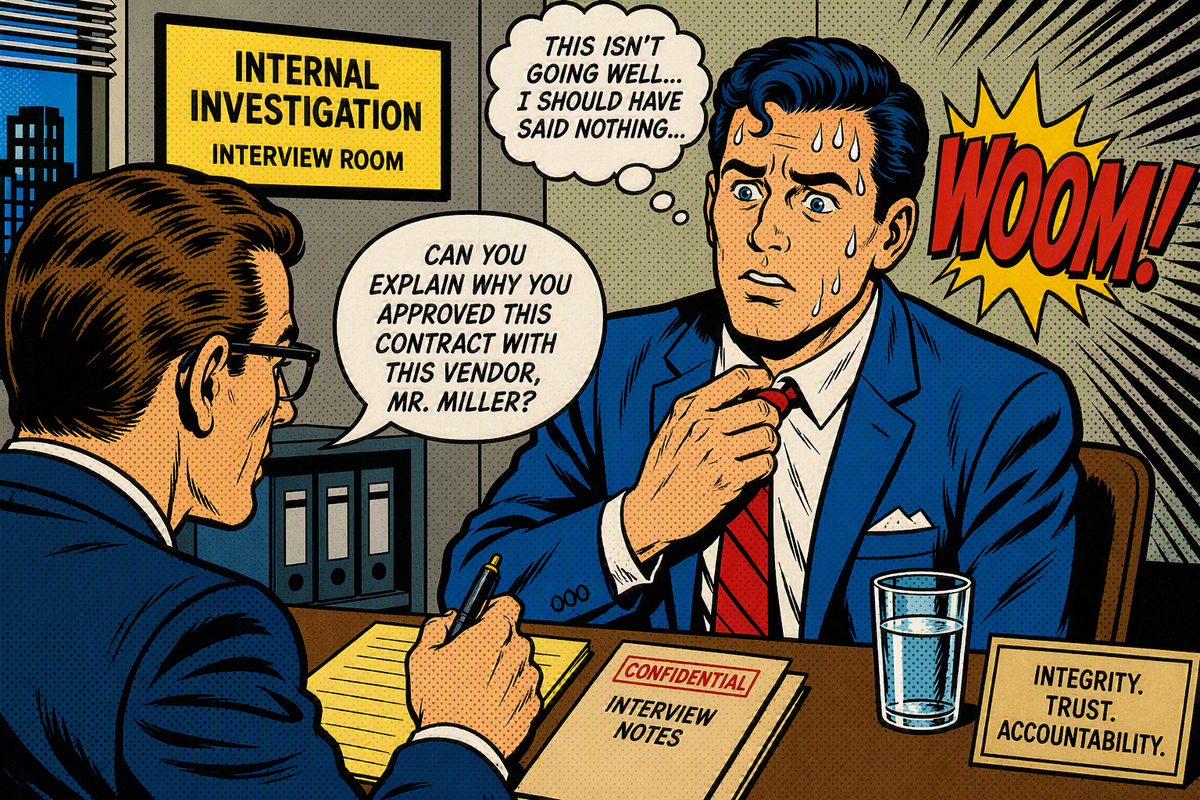
A central feature of these practices is the conduct of internal investigations whenever potential legal violations are suspected. An essential component of such investigations is the internal questioning of employees, commonly referred to—somewhat euphemistically and borrowing terminology from the Anglo-American legal tradition—as an “interview.”
What may serve as a means of gathering information and establishing facts for the company is, for the employees concerned, often a process in which they have far more to lose than to gain. This is because employees find themselves in a structurally much weaker position than they would if the “interview” were a formal interrogation conducted under the rules of German criminal procedure.
A person formally designated as a suspect in criminal proceedings benefits from a number of fundamental procedural safeguards that largely determine whether, and under what circumstances, they choose to submit to questioning at all. These safeguards include the right to access the investigation file, the authorities’ obligation to disclose the allegations in advance—thereby, ideally, creating a level playing field in terms of information—and, most importantly, the fundamental right to remain silent.
None of these protections is available to an employee being “interviewed” as part of an internal corporate investigation; nor can any of them be legally demanded from an internal investigator. On the contrary, companies in Germany can rely on the prevailing legal view that employees are generally obliged to provide information to their employer. This is said to apply even where such information may expose the employee to the risk of criminal prosecution or potentially weaken their position in subsequent criminal proceedings, particularly if interview records later find their way into a government investigation and are used as evidence.
This tension and dilemma have been extensively discussed in German legal literature and practice. Yet, to this day, no truly satisfactory solution has emerged—at least not from the perspective of employees who are asked to attend an “interview” as part of an internal investigation.